
Bad Weather? 7 Things You Can Do Now as a Drone Pilot
Rain pelts the window, the wind shakes the trees, and thick fog hangs in the valley. Your drone stays in its case – that’s annoying, but often exactly the right decision. Not flying isn’t a failure; it’s part of flying responsibly.
In this post, we first show you in which weather you’re better off staying on the ground. Then we collect ideas for what you can do instead on days like these. We base our assessment on the practice of our photo and video projects and on an engineer’s view of the technology.
1️⃣ Rain and Snow: Water and Electronics Don’t Mix
Why it’s a problem: Most consumer drones are not waterproof. Moisture can get into the motors, electronics, and battery compartment. Damage sometimes only shows up later – but then in the middle of a flight. Even drops on the lens or sensors ruin your footage and interfere with obstacle detection.
How to do it better: Check your model’s manual for what the manufacturer says about rain, snow, and moisture. If there is no explicit approval, the rule is: don’t fly.
Pro tip: If a shower catches you by surprise, it’s better to land early than to hope that “it’ll be fine.”
2️⃣ Strong Wind and Gusts: The Limit Is in the Manual
Why it’s a problem: Wind drains battery power, makes flying unsteady, and in the worst case can blow the drone away. Gusts are especially tricky because they come suddenly – on the ground you often feel them less than at altitude.
How to do it better:
- Pay attention to the wind warning in your flight app.
- Stick to the manufacturer’s specifications for your model’s maximum wind resistance.
- Always plan reserves for the return flight against the wind.
Practical tip: If you can already hear wind at takeoff or the drone has to work hard to hold a hover, don’t fly. We deliberately don’t give blanket limit values – they depend on the model.
3️⃣ Fog and Poor Visibility: No Visual Contact, No Flight
Why it’s a problem: In the open category, you must generally keep your drone within visual line of sight, as stipulated by EU Implementing Regulation 2019/947. In fog, haze, or low clouds, you quickly lose sight of the drone. The camera image is no substitute for direct sight.
How to do it better: Before takeoff, check how far you can actually see. If you can barely make out the drone, the flight is over. You can find official information on the rules at the Luftfahrt-Bundesamt.
4️⃣ Thunderstorms, Cold, and Batteries: No Experiments Here
During a thunderstorm, the drone stays on the ground – period. Lightning, sudden gusts, and heavy rain are not a mix for hobby flights.
Cold often weakens batteries significantly, and flight time may be shorter than you’re used to. Which temperatures are permitted for your model and how to prepare your batteries is stated in the manufacturer’s specifications. We describe this in detail in our post on flying in the cold.
Pro tip: When in doubt, remember: if you have to think twice about whether the weather is suitable, it isn’t.
5️⃣ At Home: Review Footage, Edit, and Retouch Photos
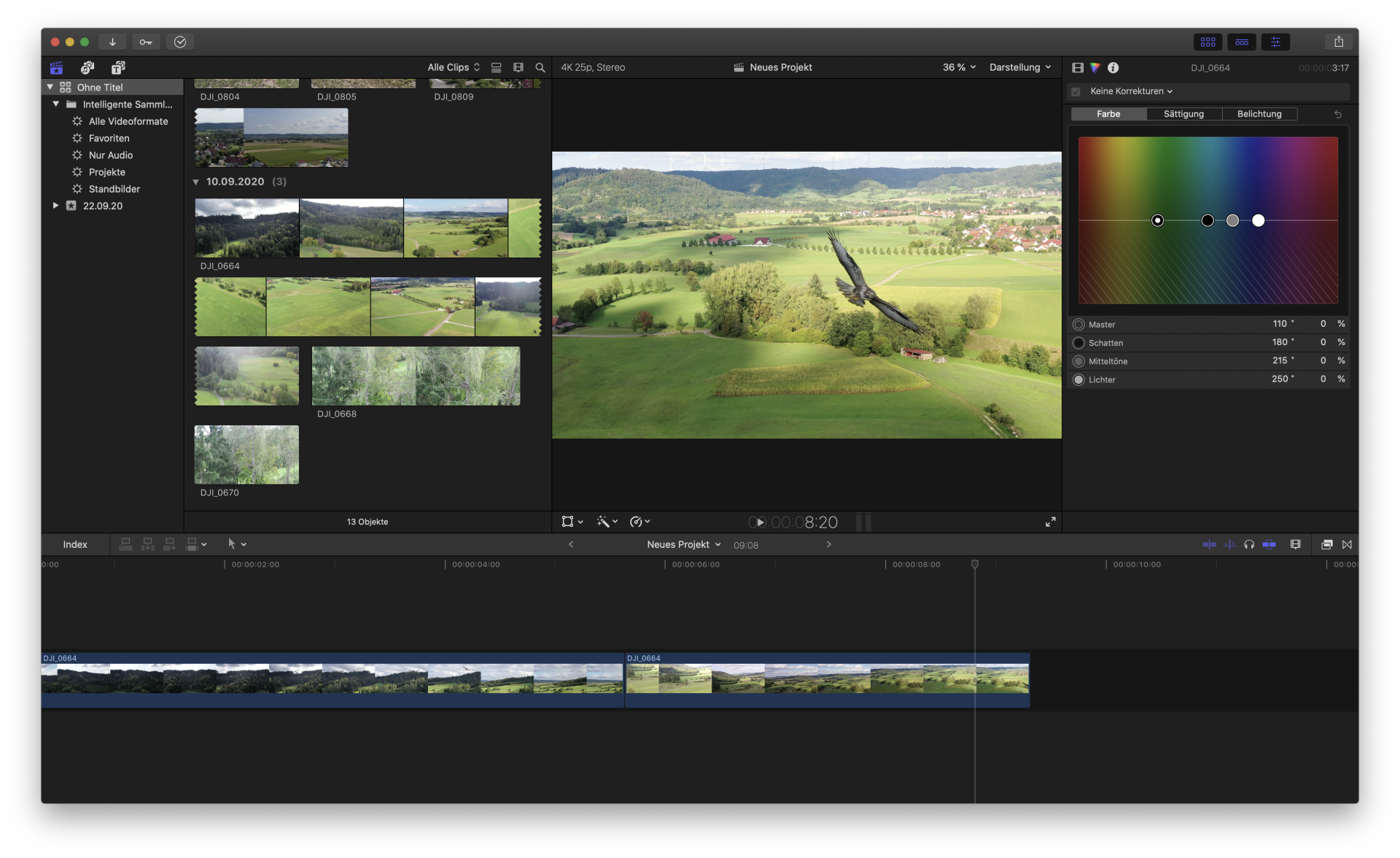
Bad weather is the best time to tackle material that has been lying around. Many clips slumber unseen on the memory card.
- Review your footage and pick out the best scenes.
- Edit videos with a clear dramatic arc: opening, climax, ending.
- Edit photos: straighten the horizon and adjust exposure and colors gently.
- Back up your data so nothing gets lost.
How to do it better: Set yourself a small goal, for example a short film of your last outing. Finished projects motivate more than a hundred raw clips.
6️⃣ Plan and Maintain: The Next Flight Starts at the Desk
Plan flights and subjects:
- Use maps to check subjects, takeoff spots, and surroundings.
- Check weather apps to see when wind and visibility are right.
- Check the position of the sun so that light and shadows suit your subject.
- Find out in advance about no-fly zones and requirements at the flight location.
Maintain your drone and batteries:
- Check propellers for cracks and nicks.
- Carefully clean the body, gimbal, and lens.
- Check batteries for damage and store them according to the manufacturer’s instructions.
- Install firmware updates calmly at home, not in a rush at the takeoff spot – and read the manufacturer’s notes beforehand.
Practical tip: A checklist for your case and accessories will save you stress later – and forgotten memory cards.
7️⃣ Practice and Learn: Simulator and Theory
In the simulator, you train controls, turns, and emergency situations without anything being at risk. Wind and landing exercises in particular can be repeated there without danger. This builds routine that gives you confidence in real flight.
You can also study theory: if you need or want to extend a proof of competency, a rainy day is ideal for learning. Which certificate suits you and how the exam works, you can find out at the Luftfahrt-Bundesamt.
Little bonus: After the rain, special images often appear – dramatic clouds, streaks of light, or wisps of fog over valleys. But you should only fly if weather, visibility, and surroundings are safe. Otherwise, you’re better off enjoying the view from the ground – and remembering the spot for the next day.
🎯 Conclusion
Bad weather isn’t wasted time. If you stay on the ground in rain, storms, or fog, you protect your equipment, the environment, and yourself – and you can use the break for editing, planning, maintenance, and training. That way, you start the next good weather window better prepared and more relaxed.
That’s exactly what drohne4all.de stands for: professional aerial photography, engineering expertise, 3D printing solutions, and responsible drone use.