
Bad weather? 7 things you can do now as a drone pilot
Rain is pattering against the window, the wind is shaking the trees, and thick fog hangs in the valley. The drone stays in its case – that’s annoying, but often exactly the right decision. Not flying isn’t a failure; it’s part of flying responsibly.
In this post, we first show you in which weather you’re better off staying on the ground. Then we gather ideas for what you can do instead on days like these. We assess this from the practice of our photo and video projects and with the eye of engineers looking at the technology.
1️⃣ Rain and snow: water and electronics don’t mix
Why this is a problem: Most consumer drones are not waterproof. Moisture can get into the motors, electronics and battery compartment. Damage sometimes only shows up later – but then in the middle of a flight. Drops on the lens or sensors also ruin images and interfere with obstacle detection.
How to do it better: Check your model’s manual to see what the manufacturer says about rain, snow and moisture. If there is no explicit approval, the rule is: don’t fly.
Pro tip: If a shower catches you by surprise, it’s better to land early than to hope that “it’ll be fine for a bit longer”.
2️⃣ Strong wind and gusts: the limit is in the manual
Why this is a problem: Wind drains battery power, makes flying unsteady and, in the worst case, can blow the drone away. Gusts are particularly tricky because they come suddenly – on the ground you often feel them less than at altitude.
How to do it better:
- Pay attention to the wind warning in your flight app.
- Stick to the manufacturer’s specifications for your model’s maximum wind resistance.
- Always plan reserves for the return flight against the wind.
Practical tip: If you can already hear wind at take-off, or the drone has to work hard to hover, leave it. We deliberately don’t give blanket limit values – they depend on the model.
3️⃣ Fog and poor visibility: no visual contact, no flight
Why this is a problem: In the open category, you must generally keep your drone within sight, as set out in EU Implementing Regulation 2019/947. In fog, haze or low cloud, you quickly lose sight of the drone. The camera image is no substitute for looking directly.
How to do it better: Before take-off, check how far you can actually see. If you can barely make out the drone, the flight is over. You can find official information on the rules at the Luftfahrt-Bundesamt.
4️⃣ Thunderstorms, cold and batteries: no experiments here
In a thunderstorm, the drone stays on the ground – full stop. Lightning, sudden gusts and heavy rain are not a mix for hobby flights.
Cold often weakens batteries significantly, and flight time may be shorter than you’re used to. Which temperatures are permitted for your model and how to prepare batteries is stated in the manufacturer’s specifications. We describe this in detail in our post on flying in the cold.
Pro tip: When in doubt: if you have to think twice about whether the weather is suitable, it isn’t.
5️⃣ At home: review footage, edit and process photos
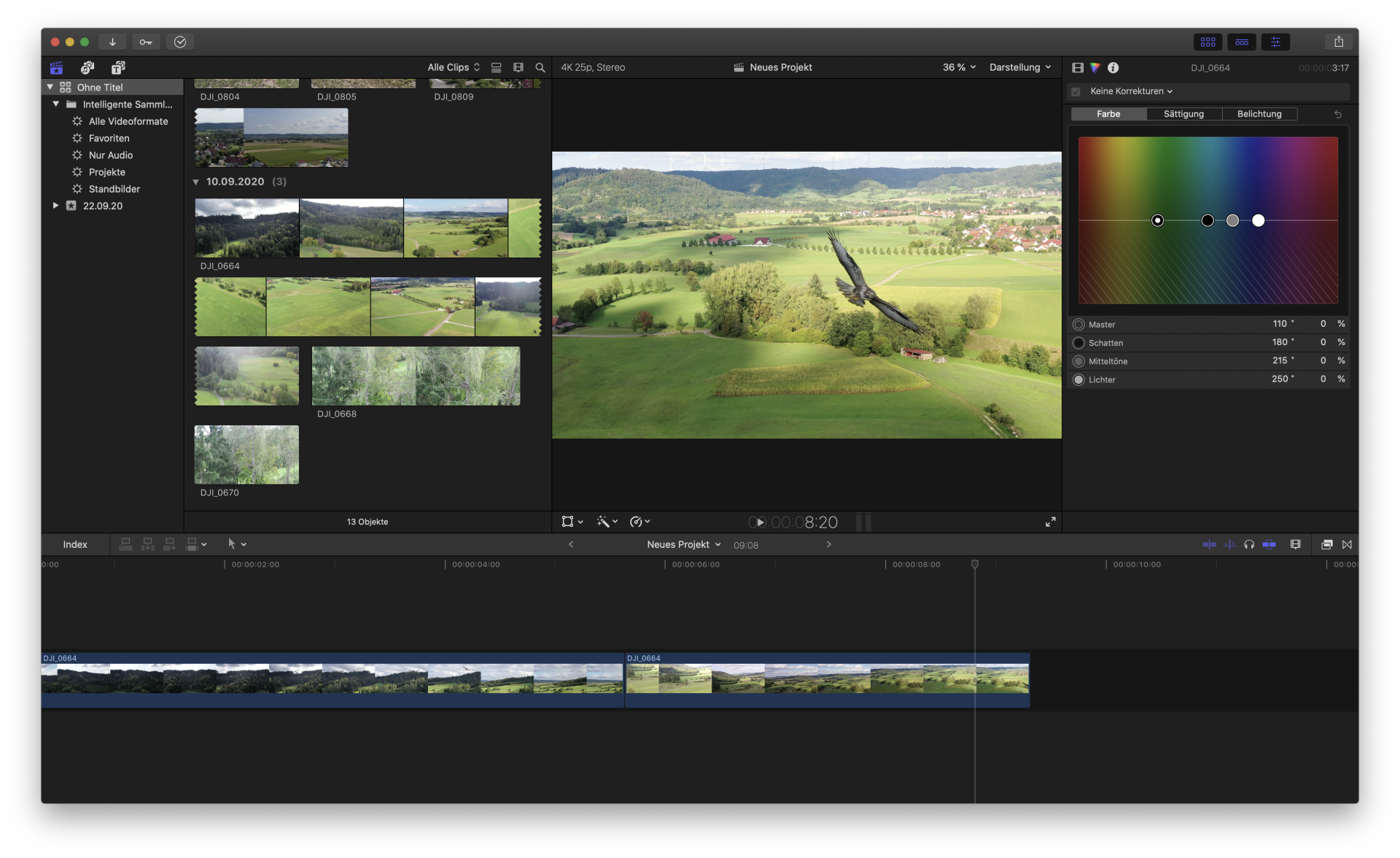
Bad weather is the best time to tackle material that has been left lying around. Many clips slumber unwatched on the memory card.
- Review your material and pick out the best scenes.
- Edit videos with a clear dramatic structure: opening, climax, ending.
- Process photos: straighten the horizon, adjust exposure and colours gently.
- Back up your data so nothing gets lost.
How to do it better: Set yourself a small goal, for example a short film of your last outing. Finished projects motivate more than a hundred raw clips.
6️⃣ Plan and maintain: the next flight starts at the desk
Plan flights and subjects:
- Use maps to check subjects, take-off spots and surroundings.
- Look at weather apps to see when wind and visibility are suitable.
- Check the position of the sun so that light and shadow suit the subject.
- Find out in advance about no-fly zones and conditions at the location.
Maintain your drone and batteries:
- Check propellers for cracks and nicks.
- Carefully clean the body, gimbal and lens.
- Check batteries for damage and store them according to the manufacturer’s instructions.
- Install firmware updates calmly at home, not in a rush at the take-off spot – and read the manufacturer’s notes beforehand.
Practical tip: A checklist for your case and accessories saves you stress later – and forgotten memory cards.
7️⃣ Practise and learn: simulator and theory
In a simulator, you train controls, turns and emergency situations without anything being able to go wrong. Wind and landing exercises in particular can be repeated there without risk. This builds up routine that brings confidence in real flight.
You can also study theory: if you need or want to extend a proof of competency, a rainy day is ideal for learning. You can find out which certificate suits you and how the exam works at the Luftfahrt-Bundesamt.
Little bonus: After rain, special pictures often appear – dramatic clouds, streaks of light or wisps of fog over valleys. You should only fly, however, if weather, visibility and surroundings are safe. Otherwise, you’re better off enjoying the view from the ground – and remembering the spot for the next day.
🎯 Conclusion
Bad weather isn’t wasted time. If you stay on the ground in rain, storms or fog, you protect your equipment, the environment and yourself – and you can use the break for editing, planning, maintenance and training. That way, you’ll start at the next good weather window better prepared and more relaxed.
That’s exactly what drohne4all.de stands for: professional aerial footage, engineering expertise, 3D printing solutions and responsible drone use.